Apple’s premium remains earned — but the bar for the next leg is high
Maz Vantage Team ·

Apple Inc. · AAPL · Market snapshot: 24 September 2026 close · NASDAQ
Apple closed at $335.92, down $1.10 (-0.33%) on the session. The company remains a high-quality consumer-technology franchise: a vast installed base, premium hardware, an increasingly important services layer, and the cash generation to keep repurchasing stock. The investment debate is not whether Apple is a strong business; it is whether future growth can continue to justify a valuation that leaves little room for operational disappointment.
The short version
Apple’s Maz Vantage Score is 4.02 / 5, labelled Strong Buy. Its strongest factor is profitability, while valuation is the clear pressure point. That mix captures the central tension in the stock: Apple is exceptionally effective at converting revenue into profit, but investors are paying a premium for that consistency.
Apple does not need a dramatic failure to underperform. Slower upgrade activity, softer China demand, or a lower-margin product mix could be enough if investor expectations remain elevated.
Revenue: the scale of the franchise
Revenue rose to $416.2 billion in fiscal 2025, from $391.0 billion in fiscal 2024. The figure matters less as a one-year result than as evidence that Apple can still grow at enormous scale while protecting its premium positioning.
Revenue: the scale of the franchise
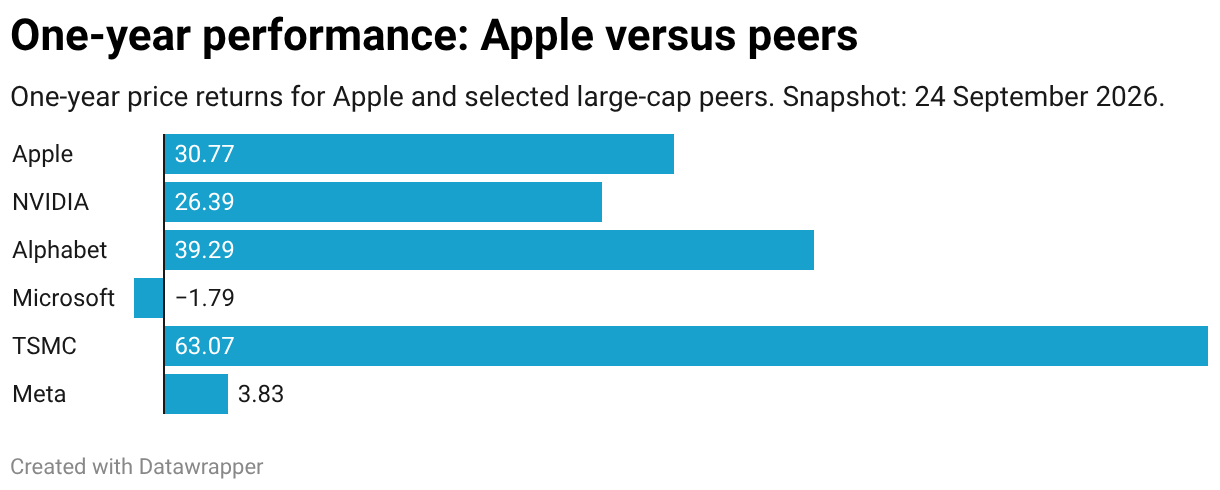
One-year performance: Apple versus peersThis content is hosted by datawrapper.dwcdn.net, which may set its own cookies. It is not loaded until you allow it.
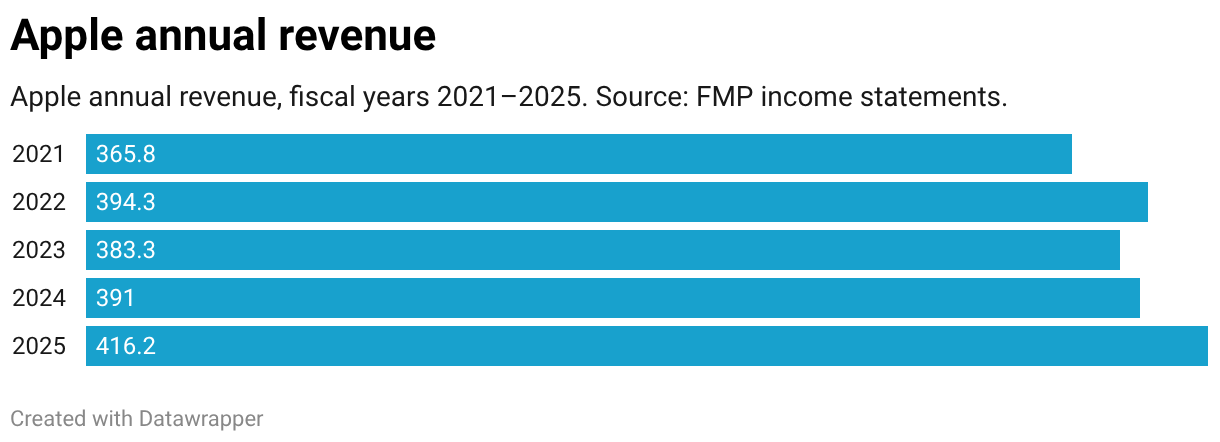
Apple annual revenue, fiscal years 2021–2025. Source: FMP income statements.
The next stage of the story is not simply about selling more devices. It is about whether hardware demand, services monetisation, and new product categories can combine to expand revenue without diluting the brand economics that make Apple unusual.
Earnings: execution has been ahead of consensus
Apple exceeded analyst EPS estimates in each of the last four reported quarters shown below. The upcoming earnings date is 29 October 2026, when the current consensus calls for EPS of $1.99 and revenue of roughly $113.2 billion.
Earnings: actual versus estimate
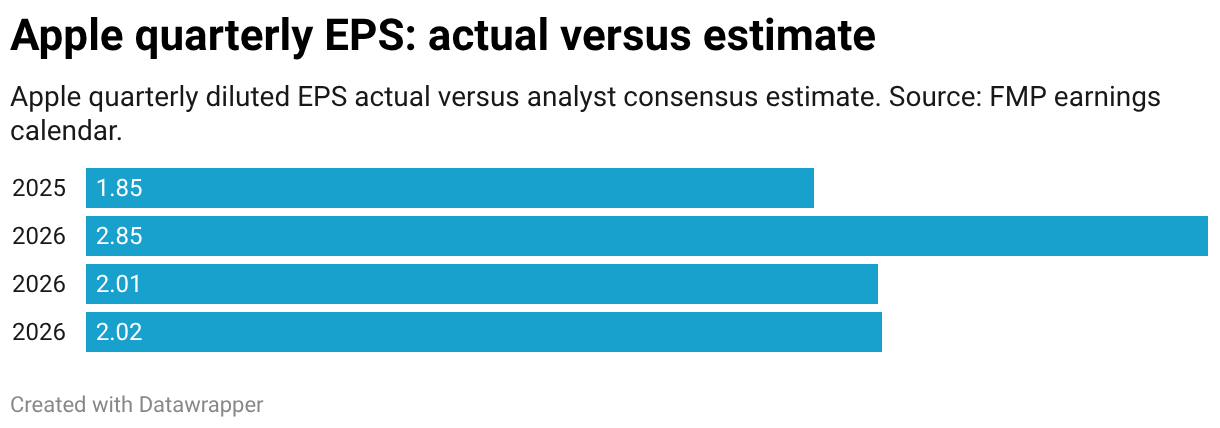
Apple quarterly EPS actual versus analyst consensus estimate. Source: FMP earnings calendar. Beating estimates is valuable, but the market will focus on the quality of the beat: iPhone demand, gross-margin direction, services growth, China commentary, and the strength of forward guidance. At Apple’s scale, the earnings discussion is as much about the durability of margins as it is about headline revenue.
Maz Quant Score: Apple versus mega-cap peers
Apple versus mega-cap peers
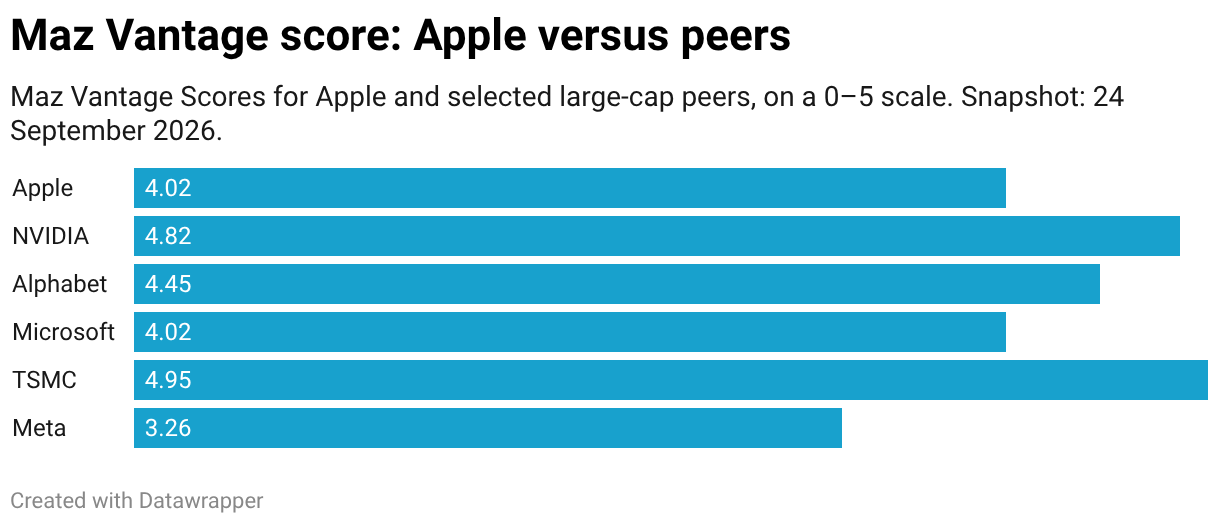
Maz Vantage Scores for Apple and selected peers, 0–5 scale.
| Company | Maz Vantage Score | Session price | Day change | Maz sector position |
|---|---|---|---|---|
| Apple (AAPL) | 4.02 | $335.92 | -0.33% | Top 24% of Technology |
| NVIDIA (NVDA) | 4.82 | $224.68 | +0.04% | Top 5% of Technology |
| Alphabet (GOOGL) | 4.45 | $342.36 | +1.34% | Top 13% of Communication Services |
| Microsoft (MSFT) | 4.02 | $497.93 | -0.53% | Top 24% of Technology |
| TSMC (TSM) | 4.95 | $450.86 | -0.07% | Top 1% of Technology |
| Meta Platforms (META) | 3.26 | $777.59 | +4.50% | Top 42% of Communication Services |
Scores and peer rankings are Maz Vantage snapshots; prices and session changes are FMP market-data snapshots.
Maz Score: Apple’s factor profile
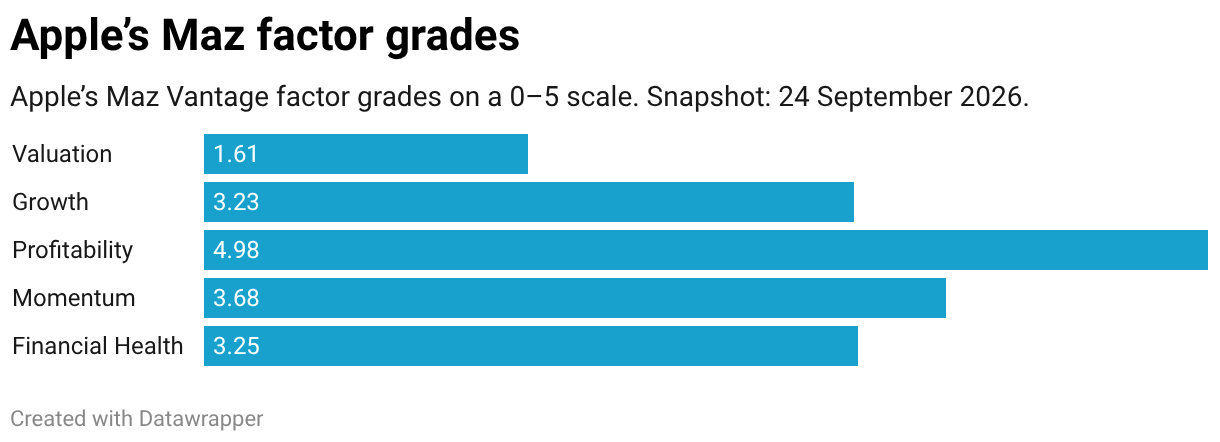
Apple’s Maz factor grades, 0–5 scale. Snapshot: 24 September 2026. Apple’s 4.98 profitability score is among the group’s strongest readings. Its 1.61 valuation score, however, says that the shares are not obviously cheap relative to the fundamentals currently priced into them. Compare that with NVIDIA, which scores highly on growth and health, or TSMC, whose 4.95 overall score leads this peer set.
What supports the bull case
Apple’s installed base turns every product cycle into an opportunity to deepen customer engagement. An iPhone owner may also subscribe to storage, music, television, payments, apps, accessories, and other services. That ecosystem makes switching less attractive and supports premium pricing.
The cash-flow profile also matters. Apple can invest in silicon, retail, content, artificial intelligence, and supply-chain resilience while still returning capital to shareholders. For investors seeking large-cap quality, that combination is hard to replicate.
What could challenge the thesis
The most immediate risk is not a broken business model; it is the difference between a very good outcome and the excellent outcome already reflected in the price. Hardware upgrades can pause, competitive pressure can intensify, and foreign-exchange or regional demand trends can affect reported growth.
The peer comparison adds perspective. Alphabet, Microsoft, NVIDIA, TSMC, and Meta all offer different combinations of artificial-intelligence exposure, cloud growth, advertising economics, semiconductor leadership, and valuation risk. Apple’s differentiation remains its integrated consumer ecosystem — but the market will continue to demand evidence that the ecosystem can drive the next earnings upgrade.
Bottom line
Apple remains a powerful, profitable, and highly rated company. The stock’s premium is supported by exceptional economics, but it also makes the next set of earnings reports especially important. Investors should watch services growth, gross margin, China demand, capital returns, and whether the company’s next product cycle expands the installed base rather than merely preserving it.
This article is for editorial-format testing and general information only. It is not investment advice.